GPS dog trackers without a subscription: what really exists (and the alternatives)
Is a subscription-free GPS tracker for your dog possible? The real options — SIM card GPS, Bluetooth trackers, radio GPS — their hidden costs, and the simplest way to be reachable if your dog gets lost.

"GPS without a subscription" is one of the most common searches among dog owners. It's also one of the most misleading. Here's what really exists, what each option actually costs, and what you can expect from each one.
Why a real GPS almost always has a monthly cost
A tracker that shows you your dog live, anywhere, has to send its position over the mobile network. That means a SIM card, and therefore a plan — whether you pay for it through the manufacturer (the subscription) or directly to an operator. "No subscription" often means: subscription included for one year, or a SIM card you buy yourself.
The options, one by one
1. GPS trackers with a SIM card you add yourself
Some trackers accept a standard SIM card: you pay for a small data plan with a Tunisian operator instead of a subscription to the manufacturer.
- The upside: real tracking, a monthly cost you control.
- The downside: the device has to be compatible with local networks, the app has to keep being maintained, and battery life is still short. So there is still a recurring cost, just paid somewhere else.
2. Bluetooth trackers (AirTag and similar)
No subscription, but no GPS either: they can only be located when a compatible phone passes nearby. In Tunisia, where iPhones are a minority, the AirTag is particularly limited. Details: AirTags for dogs in Tunisia.
3. Radio GPS (hunting-style)
Used by hunters: a transmitter collar and a handheld receiver, with no mobile network involved.
- The upside: no subscription, works far from any network.
- The downside: expensive, bulky, range limited by the terrain, and use regulated depending on the frequencies. Not well suited to a city dog.
4. The QR tag: no subscription, but not a tracker
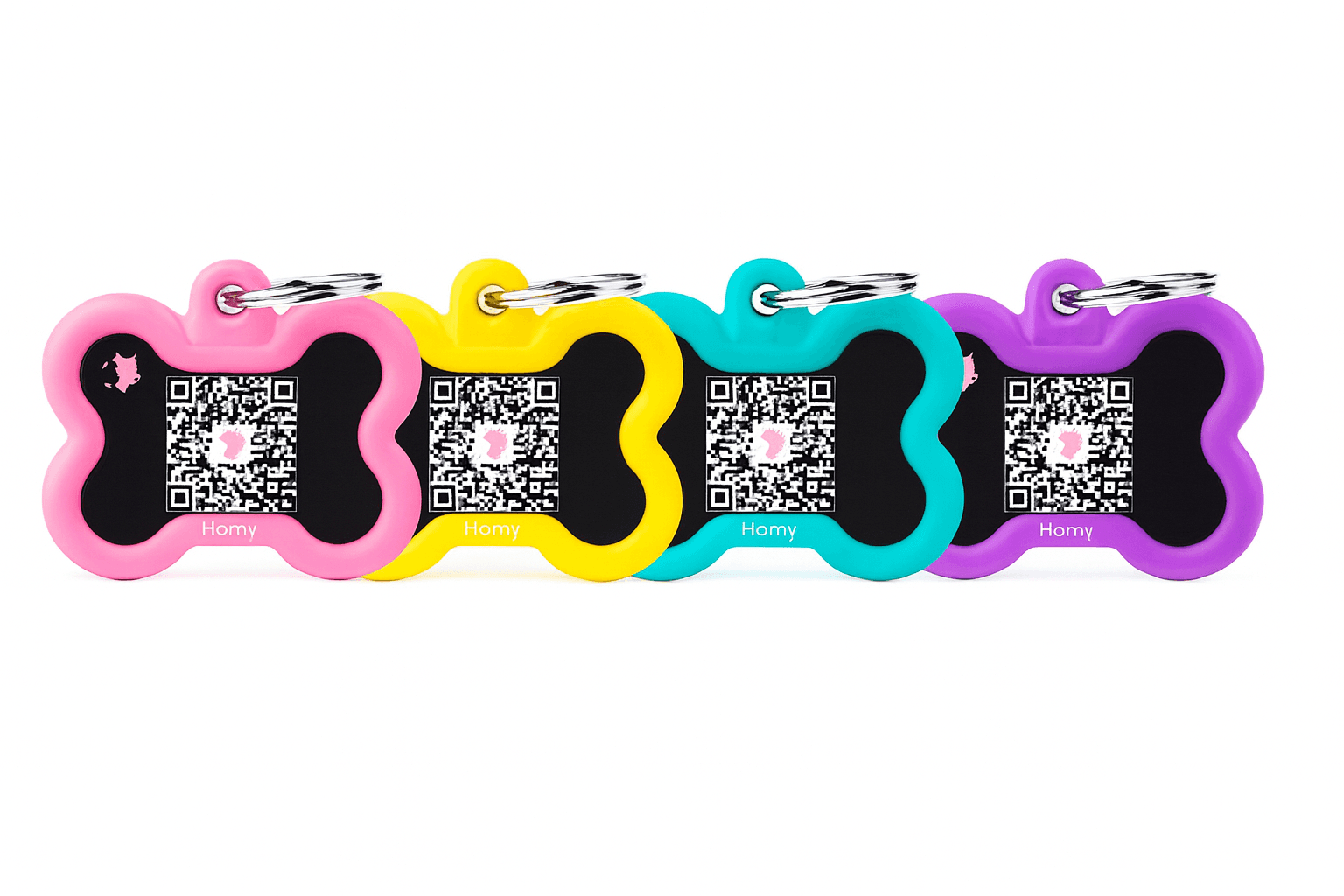
A QR tag doesn't track your dog continuously. It does something else: it lets the person who finds your dog see their profile and alert you straight away, from any phone. With Homy, you then receive an email with their number and location, if they agree to share it. If your dog is reported lost, your numbers are displayed and you also receive an email with the location as soon as someone scans the tag.
- The upside: no subscription, no battery, works with every phone, lightweight.
- The downside: someone has to find your dog.
The honest table
| Solution | Subscription | Live tracking | Battery | Works in Tunisia |
|---|---|---|---|---|
| Manufacturer GPS | Yes (often) | Yes | Needs frequent recharging | To be checked |
| GPS + local SIM | Operator plan | Yes | Needs frequent recharging | Depends on compatibility |
| Bluetooth tracker | No | No | Long-life battery | Limited (few iPhones) |
| Radio GPS | No | Yes, within radio range | Needs recharging | Specialist use |
| Homy QR tag | No | No (location when scanned) | None | Yes, every phone |
Our advice
First, ask yourself which problem you want to solve:
- your dog often wanders far, in the countryside, and you want to track them: a real GPS, accepting a monthly cost and the recharging;
- above all, you want your dog to be brought back to you quickly if they escape: a QR tag, worn at all times, is the most reliable and simplest solution.
The two work very well together: the GPS for searching, the tag so that people can alert you — even when the GPS battery is dead.
A tag that brings them home.
Waterproof QR tag. No app, no subscription. Whoever finds your pet scans it and alerts you in one tap.
See plans