GPS dog collars: what manufacturers don't tell you
Subscriptions, battery life, network coverage, accuracy in town: before buying a GPS collar for your dog in Tunisia, here's what you really need to know and the questions to ask.

"Track your dog in real time, anywhere." The promise of GPS collars is appealing. The reality is more nuanced: a GPS tracker can be very useful, but it comes with constraints the ads keep quiet about. Before you buy, here's what you need to know.
How a GPS collar works
The unit works out its position using satellites, then sends it to your phone over the mobile network (like a small phone), thanks to a built-in SIM card. With no network, the position is calculated but never reaches you.
What manufacturers don't highlight
1. There's almost always a subscription
To transmit its position, the collar uses the mobile network: someone has to pay for that connection. That's why most trackers sold in Europe require a monthly or annual subscription. Also check that an imported device actually works on Tunisian networks, and under what conditions (roaming, whether a local SIM card can be used or not).
2. Battery life is often disappointing
A few days at best, sometimes less than a day in live tracking mode. A dog that's been lost for three days with a flat battery can no longer be located. The collar needs recharging very regularly — and it's often on the day you forgot that your dog runs off.
3. Accuracy varies a lot
In town, between buildings, the position can be off by tens of metres. Inside a building, a garage or an underground car park, GPS struggles. In rural or mountainous areas, it's the mobile coverage that may be missing.
4. Update frequency matters more than "range"
A collar that sends its position every 5 minutes shows you where your dog was, not where they are. For a dog on the run, the gap can be huge. Check the update frequency in "search" mode and its impact on the battery.
5. Size and weight
A GPS unit is heavier than a tag. For a small dog or a cat, it can be uncomfortable, or even unsuitable.
6. Heat and water
In a Tunisian summer, a black unit in the sun heats up, and batteries don't like heat. Check that it's waterproof if your dog swims.
The right questions to ask before buying
- What's the total cost over 2 years, subscription included?
- Does it work in Tunisia, and with which operator?
- What's the real battery life in tracking mode?
- How often does it send a position in search mode?
- What happens if there's no network, or if the company shuts down?
GPS or QR tag: two different roles
A GPS is for searching for your dog. A QR tag is so that someone who has found your dog can bring them back to you. In real life, many reunions happen because a passer-by was able to call the owner, even when the GPS battery was dead.
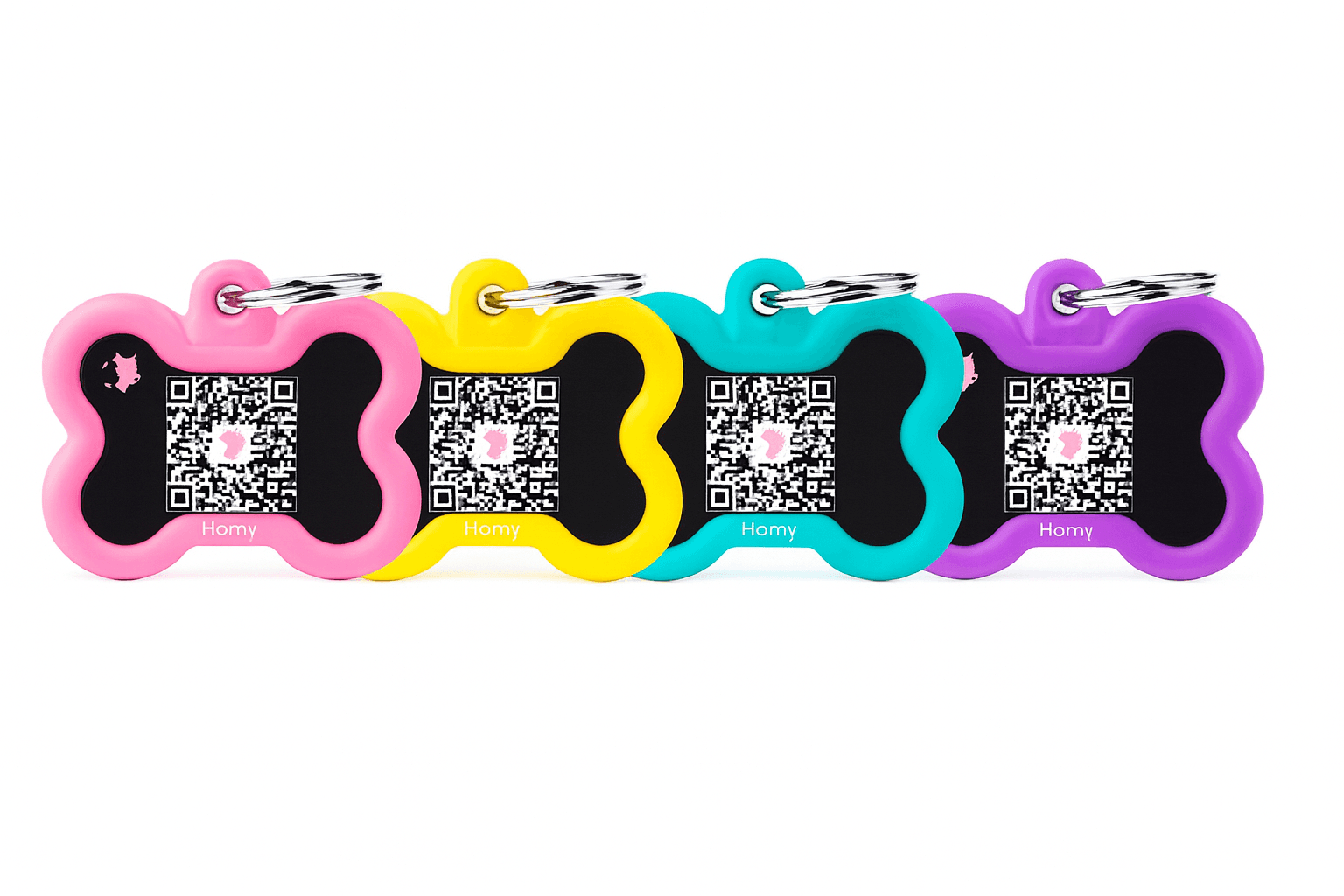
If you choose a GPS, keep a Homy QR tag on the collar too: it has no battery and no subscription, and it always works.
Also worth reading: GPS dog trackers without a subscription: what really exists and AirTags for dogs: do they work in Tunisia?
A tag that brings them home.
Waterproof QR tag. No app, no subscription. Whoever finds your pet scans it and alerts you in one tap.
See plans